Sunday, August 19, 2012

Symbolism of rugs in Anatolia: My Soumak and an old friend, Kathy Hamilton

**First blog from Istanbul! I’m finally back!**

One day a Yürük tribal chief saw a kilim rug lying on the ground by a tent. Looking at it brought anguish to his heart, so he called on his men to find the father of the girl who had woven that kilim rug. 


When the father of the girl was brought to the tent the chief asked:


"You have a daughter, don't you?"

"Yes, I do" replied the father.

"As I understand it," continued the chief, "you want to marry the girl to someone she doesn't want. She has set her heart on another.”


At first the father was stunned - how could the chief know of this - but then his tongue was loosened:


"That's true, I'm a poor man and the man who wants to marry my daughter is rich, so I promised to give him her hand in marriage. My girl, though, lost her heart to a poor young man…but how could you know of this?"


The chief pointed to the kilim rug on the ground saying:


"Didn't your daughter weave this kilim rug?” 

"Yes, she did" said the father, to which the chief replied:


"So I knew about it from the language spoken by this kilim rug…I'll give you a horse, a camel, go and marry the girl to the one she loves. Oh! and tell her this…she wove it well, but she should put a bit less of a green accent by the red…as it is, I was almost misled."

Murat! Friends since my first trip to Turkey in 2001.
My my, the past two years of living in Canada have gone quickly. For those of you who have followed my blog, you’ll remember a few years ago I took a textiles class at UBC. I had to do a presentation on something to do with textiles and so I chose to do my presentation based on a soumak I bought a few years back in Turkey.

I have a friend who sells carpets in Sultanahmet, Murat at Artemis Rug Store on Akbiyik Cadesi/ Adliye Sokak. We’ve been friends for years, and once I stopped in to say hello, and saw this soumak hanging on the wall and fought with Murat to sell it to me. He didn’t really want to part with it, knowing he’d probably get a higher price from a richer tourist, but I insisted, and I still love it to this day. (In fact, it has been on my floor in the UAE, Istanbul in 2009, Throughout many bedroom floors in Canada, and now it has come home to Turkey and it's lying five feet away from me as I type this!)  I now avoid looking at walls in Murat’s shop, though! He also says he won’t sell me anymore rugs and I ought to take my business elsewhere, but the truth is, Murat has amazing carpets and I’m always guaranteed an honest price and honesty about the quality of the piece and where it comes from. (My sister and I once locked him out of his own shop and went through his merchandise- which he thought extremely funny, but that’s another story!) 
Kilim weave

Okay, what is the difference between a carpet, a kilim and a soumak? Rug 101 coming up.

A carpet is the kind of carpet you know of- it’s thick and has a pile. Carpet weavers tie each piece on and cut it according to a pattern they usually have taped to the side of the loom. 

Soumak Weave


A kilim is a flat woven carpet, and can be reversed. It takes more skill and some critical thinking skills in order to work the pattern and still keep the structural integrity of the rug. because the colours don’t overlap there is often a small gap between the colours, so the kilim needs to be planned out in such a way that these slits aren’t too long.

Mine in particular is a soumak, which is very close to a kilim, except it’s embroidered as well as woven, and can’t be reversed, and has a different kind of weave.
Kathy Hamilton and her son. 
Lucky for me, I have lots of interesting and intelligent friends in Istanbul. Meet Kathy Hamilton from Texas and her son. This picture is a few years old, taken on the day that Kathy, her son, my sister and I stalked Obama on his trek between the Blue Mosque and Hagia Sophia. Kathy is the shopping tourists dream, as she has researched and organized tours of the Grand Bazaar to help people navigate the crazy number of stores there: Not only can she tell you the history of the Bazaar, she knows where to get the best stuff for the best price. She also knows a lot about kilims, so I showed her my kilim and she helped me deconstruct the story over a cup of tea one day. 


My soumak and what it means! 
(As deconstructed by Kathy and me)
(Mini disclaimer: Neither of us claim to be experts!)

Animals and Ram’s Horns inside a burr design. 
Animals, most likely livestock that needs protecting. the two little squiggly S’s are snakes, a symbol of renewal and protection. The two blueish symbols in the middle are ram’s horns, symbolising fertility in males, heroism, power and masculinity. In its earliest forms, ram’s horns were curvilinear and used in felting in Central Asia. They only became geometric because of the constraints weavers have of making curvilinear forms.


The oatmeal-coloured  shape you see is a burr (burdock) shape.  Burrs often get stuck on humans and animals that live very close to nature, and it is believed that the burr can ward off the evil eye.  It can also mean “full of flowers” and so therefore it’s often depicted on the side of flour bags in Anatolia. By putting her livestock and ‘ram’ in the burr pattern, the weaver is protecting her family and security. 


Snakes, dowry chests and a broken evil eye/cross. 
Working from the outside line, the linked S pattern is the snake again, encircling the entire carpet, thus protecting everything inside its design. 

The snake is a protection of life symbol. As it molts its skin every year, it has become the symbol for immortality and reincarnation and eternity. The snake is also the caretaker of the tree of life, which also symbolizes eternity. A black snake represents happiness and fertility, because of its real life form resembling a phallus. 


Next up are trousseau chest symbols, the dowry chests of young Anatolian girls, with a cross inside. this isn’t a coptic cross though, this one splits the evil eye in four, sending its ill-will in four different directions, warding of anyone who might be jealous of this bountiful dowry chest! The evil eye is a widespread popular motif and is still widely used to ward off jealous stared and curses. It is believed that some people have the power to inflict harm, injury, misfortune or even death with a glance, and the best way to fight off this evil eye, is with another human eye. The evil eye is a stylized representation of a human eye and can also be represented as a diamond split into four.

Coffee cups, oil lamps and water jugs and animals inside a burr.
Another burr pattern with oil lamps, water jars and coffee cups among the plentiful animals. I admit, the jars and coffee cups are what initially attracted me to this soumak, and I have yet to see another one like it. I thought perhaps these were a literal depiction of things you might find on an actual soumak being used out in the field.

 But now I know vessels hold water, a precious commodity for a nomadic tribe, moving their animals around looking for water and suitable grounds. A vessel is also a symbol of fertility as pregnant women are also vessels carrying new life. The ewer, or long spouted vessel found on the top and bottom is also a symbol for pregnancy and cleanliness. Since it is one of the household objects used daily, it is often seen on Turkish prayer rugs and kilims.  It reminds the faithful to perform ablutions before prayer.  It also represents washing after sexual intercourse, so it’s also a symbol for the wish to have children. The weaver is most likely hoping for an abundance of water and possibly an abundance of children in her future as well! The oil lamps could represent modern convenience or even Islam, as lamps are often included in prayer rugs to symbolise “the light."

First quirk: half a star.
It’s interesting to note that there are always “mistakes’ or quirks in a handwoven kilm/rug/soumak. There are two reasons for this: The first one being that only God can make perfect things. The second is that it proves the carpet wasn’t made by a machine. 

There are a few quirks on my soumak- one being half a woven star, the yellow and white shape. This simply symbolises happiness and fertility. If there are many stars on a kilim is means the weaver wishes to express her utmost happiness in life. Taking into consideration the mother goddess statues where the star symbolises the womb, it could be said that the motif is related to fertility. Due to technical weaving difficulties, the star motifs have an even number of points.

Second quirk: Half a lamp.


Besides there being a few animals with three legs, it looks like the yellow oil lamp also got cut off. 


Third quirk: A weird thingy. Someone enlighten me!


I’m not really sure what that little shape next to the oil lamp is. My guess is that it’s a flower bud maybe? or an earring? Earrings are given to bride during the marriage ceremony and symbolises marriage and the desire to get married. It shows weaver's expectations for marriage. It’s a possibility that this is an earring, as it would be fitting with the theme. Though it kind of reminds me of a curling rock from Canada! 

Favourite quirk: Escaping bird!


And my favourite little quirk of all, this little bird trying to make it’s escape at the very top of the soumak. It’s almost like he’s saying, I’ve made it past the first ring of snakes, now it I could only get past this next ring I’ll be freeee! 


Kathy’s take: 

My take on it is that she is young, but very close to marriageable age. She is hoping for a marriage with a good man who will treat her well. She also hopes for half a ton of kids. I think that in addition to showing the material things she dreams of - a home, all the necessities for a home, livestock, etc., I think that she is also giving a picture of her world. I think that the fox-ish animal and some of the birds could represent the wildlife that is around her home. If she is living in a tiny village, or a part of a nomadic unit, she is aware of the fact that there are those around her who are prone to jealousy of someone who is happier, has a nicer husband or more children, and so she is trying to protect herself, and her dreams, from the evil eye.

Or, she’s wishing Starbucks would come to her village!

You can see a short little video of Kathy here and contact her on her website @ Istanbul Personal Shopper . 

You can find Marat and Artemis Rug Store at their website,  here.

Off to meet a new friend under Galata Bridge! It’s nice to be back!  

xxMelanie

Saturday, June 2, 2012

A Hill with a Bike on it Stands a little Taller: Cycling in the City!

My friend Lorens' awesome bamboo bike! The "fiberglass" joints are made from hemp and soy epoxy.
Apparently you can find online instructions to make your own, but Loren's friend made Loren's.

Now that spring is almost on it's way out and summer is on it's way, I manage to get out on my bike when it's not raining. I love cycling. Not like, I have to wear everything spandex and go shooting through the city cycling, But a nice ride along streets I haven't been on before, maybe just a hair of my usual route lets me explore all sorts of things I'd miss if I were walking or on the bus. 


Take all my yarn bombing spottings. Most of them have been in the company of my bicycle. But I have also found a few other interesting things in the city because of cycling. 


Roundabout Gardens: 
These are community gardens found in the roundabouts in Kitsilano. If I were living in a cramped little apartment in Kits and staying long term, I might take one of these over. How fun! These guys invite you to take what you need, but they never seem to run out of anything.


And now that I ride my bike up the big hill to UBC, I was quite pleased to encounter this other form of nice graffitti- Stenciled right in the bike path lane right at the top of the hill it says, "A hill with a bike on it stands a little taller." The kind of graffiti I can get behind. 

Yay Bikes!
xxMelanie

Friday, May 25, 2012

April Showers Bring May Flowers: Yarn bomb spotted!

I hate moving. Haaaate!

Since moving back to Canada, I have moved nine times. Seriously! Whoever said I should move back to Canada for some stability in my life, should think again! I've never moved this much! Ever! 

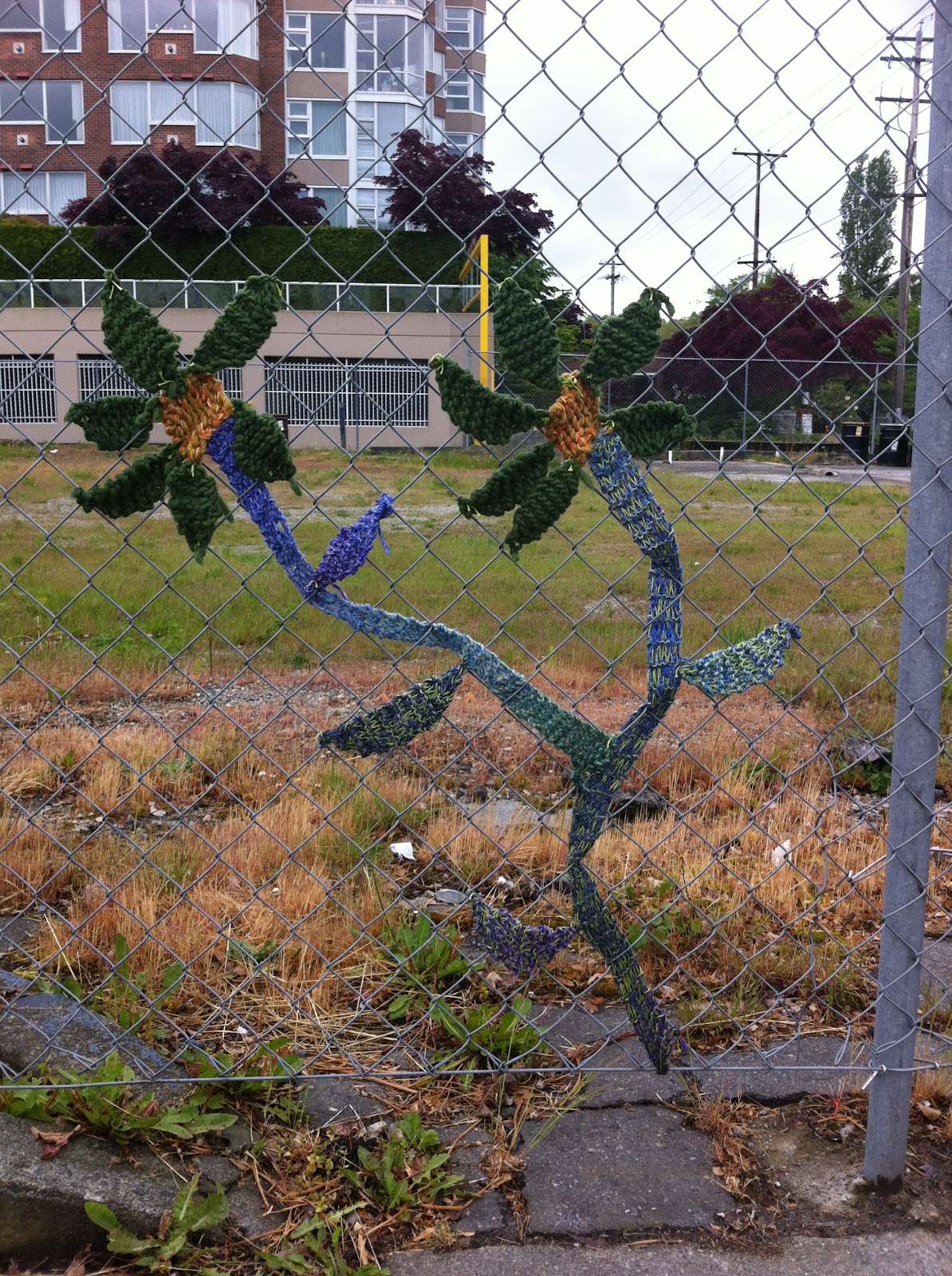
However, all of this moving had an upside this last time around. While I was shuffling my things between my new and old house at the beginning of May, I discovered probably the most ambitious yarn bomb I've seen so far. 

This one is on Fourth Avenue West near Collingwood St, (I think, I cant' remember exactly). I've passed it so may times on the bus, trying to snap a picture out the window, but I had never been successful. Luckily one day I decided to ride my bike a different way to my yoga class and I happened across it again. So bike thrown down on the sidewalk much like I did as a kid, I snapped a few pictures with my phone before I continued on my way. 

A few new flowers for May!
 (Now if only the rain would stop, Vancouver!!!) 

The long view of the fence.

The flowers would have been knitted into shape then "sewn" onto the chain-link fence. 

Notice the cloud! I wish they had filled in the cloud somehow. 

Okay, the cloud could have been a lot better, but I won't complain! 

If I had time and some knitting skills I'd go add bees and butterflies. 

Yarn grass would be pretty cool too. 

I love how these flowers blend into the field behind it. They don't look out of place at all!

The long view from the other side. 

Pink Poinsettia-looking fleur. 

Thank you for the inspiration, Flower Yarn-Bomber!

You have also made my dreary moving duties a little bit brighter with your unsanctioned street installation!


Ps. If you are in the Victoria (British Columbia) Area and would like to donate some yarn to a yarn bomb tree Installation, Go to:
This link! 


xxMelanie

Tuesday, May 1, 2012

Seriously Syria: Aleppo and the End of our Trip to Syria


 "You can no more win a war than you can win an earthquake."
~Jeannette Rankin

Thursday, August 2, 2001

And so our whirlwind tour of Syria continued on to Aleppo, our last destination in Syria. This time we bought our tickets directly from the bus station as Hama is a much smaller place than Homs. To be honest we were quite unsure as to why we were going to Aleppo, but it was a natural place to go after Hama- and it was also designated at UNESCO site.


The old part of Aleppo was famous as a market city. The main attraction is the Souk which is located in the center of town next to the Citadel. Aleppo has actually been a market town throughout history- It was the capital of the scavenging Amorite kingdom- people who lived off the bounty of the neighbors. But in 1650 BC, the Hittites came and attacked them. The Amorites realize their future was not in stealing fortunes but in earning them. The Greeks arrived in 331 BC and realized Aleppo's potential as a market town. The Persians decimated and devastated it in 614. The Mongols devastated it twice once in 1260 and again under Tamerlane in 1400. A huge earthquake in 1822 reduced much of the city to rubble. But aside from the markets Aleppo has 470 mosques 39 churches 69 caravanserai's and 58 public baths, most which were built in the Mamluk style. 1.5 million people can call Aleppo home. 

Our first attempt to see the city resulted in us getting majorly lost. We somehow ended up behind the old city entering through some door we first thought was forbidden. But since no one stopped us we continued and found ourselves in a serious maze of streets and from the looks on the people we passed, this area wasn't visited much by tourists. But it was obvious we were in the old city, streets find with old cobblestones, narrow alleyways and only possible to be traversed by foot or bike for little boys came barreling down on bikes,  narrowly missing these two lost foreigners! Finally we reached the back end of the Souk but we really only reached it by a total fluke. 

Wandering through the Souk, I really felt like I was back in Damascus. The same stuff being sold in general except this time at much lower prices. We still didn't buy anything. René had some money to burn as we were planning to cross into Turkey the next day but alas, nothing caught our eyes. We stopped and bought some ice cream and sat on a curb to eat it before it melted. I know we got strange looks from the Aleppians that passed by , but really we got our full share of dirty looks and stares anyway it really didn't matter what we were doing at anytime.


 A boy and his friend walked by holding hands.
 "Where are you from? Canadian?" He asked. 
"Yes," we answered a little bit puzzled, neither of us were carrying anything that gave our nationality away. "Vancouver?"
 "Yes!" we answered. 
"Welcome to Aleppo, eh?" He said, and disappeared into the souk with his handholding friend.


 I only mention this because we ran into him again. – Bashar was walking hand-in-hand with someone who was engaged to his sister. He invited us to his friends shop for tea, but not before he spit out 1000 idioms, rhymes and puns at us. "Life is pretentious!" Seem to be one of his favorites along with "I am not gay but the man I sleep with is." He told us to come drink tea and discover ourselves. We decided it was worth a tea! 

So off we went to the shop, called Sebastien which was chosen because it was the name Oscar Wilde apparently adopted after his homosexuality scandal. Hussein the guy who ran the place, had a thing for Oscar Wilde and apparently something for a man who worked for the Syrian Embassy in Canada. It was for this reason he was immigrating to Canada. Bashar told us Thomas, who  had left "man-hickeys" all over Hussein, was in the closet and married with kids. Bashar thought he would probably leave his wife once Hussein arrived in Canada sometime in October. 

Bashar also had another friend named Emad who was busy selling some French tourists some silver jewelry. He spoke French fluently and just as he was closing the deal one of the precious necklaces broke all over the floor sending bobbles and beads bouncing over the cement floor. "Lock the doors!" Emad shouted. "I bet these tourists are trying to steal something!" 

After the French tourists left, we headed to Emad's tiny shop in the Souk. We sat in there, eyeing up the mosque lamps unbeknownst to the him and watched him smoking Nargileh, otherwise known to us as sheesha. We talked for a while sucking back more tea and watching Bashar work through all the music they had. Young boys of 24, I couldn't help feel they had carved out a little crazy liberal niche there in Aleppo that didn't really exist anywhere else. They should move to Dahab! We tried to extricate ourselves from the shop but this ended up in us getting a mini-tour of the old caravanserai in the Souk.


 We promised to meet the boys for dinner after a jaunt around the old city. But according to the boys we had pretty much seen everything. And that seemed to be pretty much true, so Rene and I decided to leave to Turkey one day early. We had some time before dinner so we wandered around the Souk, chatting with some of the vendors. The weird thing is all the people we stopped to talk to in the Souk designated their sexual preference to us. "Hello, I am Mustafa and I am not gay, really."

 Another weird thing is that this day I decided to wear my hair in buns on the top of my head. This is not an  unusual hairstyle at home, nor the first time I wore my hair like this on a trip, but for some reason, today nobody could keep their hands off of them. Bashar almost ripped my hair out with all of his grabbing! He said I looked like a little kitten and begged me to meow. Just looking at me thinking about those little buns would send him into serious hysterics! Finally, at the restaurant I took the little buns out as they were now hurting. I put a big one in and now I was apparently a chicken. Sigh!

Here the boys smoked more nargileh. We ate the usual fare- hummus, pita, vegetables, some lamb and chicken. The restaurant was only a nighttime deal, being situated next to a large community center- like swimming pool. The five star washrooms were actually grubby change rooms. But our boys told us they liked it all five star. 

Soon into the dinner, I committed social night suicide. I lied to Bashar and told him I had a great boyfriend back in Canada. He told me he wished me no ill will, but would I consider changing boyfriends for a night? I said no, my fictitious boyfriend was a really good man.

Bashar ignored me for about half an hour, not speaking to anyone. To be honest, this was really annoying to me as I was still available for witty and interesting conversation, but there was none of that. Instead we watched René thwart Imad's attempts until it was time to leave. 

After dinner We went for a big walk and Bashar began to talk a lot and in fact I think our conversation was better since the sex thing was out of the way and we could talk like friends. He said he had some cheating girlfriends so he realize that I was a good one since I wouldn't cheat on my non-existent boyfriend! 


Since we were off to Turkey in the morning, we promised Bashar we would meet him for breakfast. We had our usual fill of pita cheese and jam. Then off to the bus we went. Bashar came with us to say goodbye and asked if there was any chance we could stay longer in Aleppo. There was still so much he could show us! Another one asking us to stay a few extra days! We showed him our paid for bus ticket, shook hands, and said goodbye and got on the bus. 

Goodbye to Syria! On to Turkey. 

xxMelanie

Sunday, March 4, 2012

Seriously Syria: A Visit to Qala'at al-Hosn (Krac des Chevaliers)

"A journey is like a marriage. 
The certain way to be wrong is to think you control it." 
~John Steinbeck


So on to Homs where we went through the same rigmarole with the annoying touts and bus companies shouting and pulling us in all directions.  But within a short time we were en route to the Crac des Chevaliers, known in Arabic as Qala'at Hoseyn. 
This is the Crusaders' greatest legacy and the best example of military architecture in the Near East. Some guidebooks say it's the best preserved castle in the world! When in use, the Crac could hold 4000 soldiers and 400 knights. The Crac is in a strategic place- it overlooks a gap in the Lebanese mountains which was once a major thoroughfare between the Orontes and the coast. And it was designed to intimidate the folks who utilized that route. 

It was built over several years, starting in 1142 and was in use for 129 years. The Crusaders resisted 12 attacks including those led by Nehruddin in 1169 and Saladin in 1188.  They were eventually starved out by the Mamluks under Sultan Baybars after a 45 day siege in 1271. After the Mamluks left, the castle wasn't in use and during the Ottoman reign a village of 10,000 lived in there. The French kicked them out in 1936 and the villagers built a new village below with materials they looted from the Crac.

 Because the last bus back to Homs left at 3:30, René and I had just over an hour to see the entire Crac. We ran  from room to room, checking out the secret passages and views from the tower windows. It was a cool castle and it's true it was of the type fairy tales were made of! Our experience there was good, except A Syrian man followed us around trying to show us things. Though this was not unusual ad he was nice enough, we actually barely had any money. I had none, and there was no place to change at the Crac. As well, the way he spoke Arabic let us to believe that he was deaf which compounded our guilt. We spent much of our time uncomfortable and trying to ditch him. The worst part was that he never asked us for money and said goodbye as he walked off with a friend so maybe hospitality was his only motive and we blew him off. Or maybe not. Who knows? Still I felt horribly guilty.

Now was a time to leave the Crac and get back to Homs- or Hama- where we decided we would rather stay for the night before heading on to Aleppo. The minibus driver insisted it would cost us 200 a piece to take us to Hama, but he would take us there directly. We argued with him that this was too expensive but he insisted. I got him to agree to 350 for the two of us (not much of a discount) which he later dismissed as a fee for taking our luggage. I was pissed about this as we had our luggage the whole time we had been bartering.

However close to Homs, (as we figured out we were not going directly to Hama) we saw people take out their money and pay the driver significantly less. When got out, the driver freaked out and insisted we get back in as he was going to drive us to the bus that would take us to Hama. I asked a Japanese boy how much he had paid to get Homs- 35 pounds he answered! how much to Hama? I asked.  Seventy was his reply. I fought with the feisty driver who tried to act innocent but accepted our collective 70 pounds and an offer to drive us free!  But we wanted nothing to do with him.

 At the next Hama ticket booth the man seemed to want us to forget that we had change coming. We kicked up such a fuss that we did get a change back twice! Once directly to René and one and one more time to the bus window to the Japanese boy. By the time we realized the mistake it was too late! Oh well! Win some, lose some!

So off we went to Hama, the land of the waterwheels! On the way, I read up on the history of the town and was surprised that Hama's (somewhat) recent history was not included in René's Lonely Planet. Hama boasts a bloody past. The Arameans, a prosperous group through their trade was with the Israelites, came to blows with the Assyrians who came to loot them.  In 722 BC, the Asyrians finally defeated the Arameans after decades of trying and devastated the town. 

This happened a lot over the ages, just as the names of victims and assailants have changed. The most recent attack on Hama was in 1982, by its own dear President Assad. In 1980 there was an attempt on President Assad's life by the Muslim brotherhood. Obviously the assassination failed; Assad himself kicked one of the grenades thrown at him out of the way. 


Assad laid low biding his time until the time was right and exact his revenge on the Muslim brotherhood. In February 1982 after a coalition of revolutionaries published an antigovernment manifesto, the government closed off the city, ordering first an aerial bombardment and then a land invasion by the army. There was a news blackout so details are hazy but it has been estimated that between 15,000 to 25,000 civilians were murdered in the massacre. Many others died in Syria's prisons.

Apparently an example was made of Hama, as there were a lot of revolutionaries in Aleppo as well. Again coming from Canada I can't imagine having a leader who would do such a thing. Honestly no one wants you in power, then get out! Why would you want to inflict all that misery on your own people? I highly doubt dictators are happy people.

 Even though we were looking at Hama as only a stopover, we took advantage of our time there to go out and see what we could of the place. It seemed like a nice little place, lots of green park area coupled with outdoor restaurants along the river and tons of people out walking, though it was only Wednesday night.

We wandered up and down the streets, sampled some extremely greasy falafel and decided on eating whatever Hama was most famous for- which was an almond flavored cream filled crêpe- although the substance inside was much thicker than cream. We saw the Norias, the famous waterwheels and then retired to our hotel in the evening. We tried to get some sleep but apparently our hotel was on one of the main streets and a few weddings went by to add to the already ludicrous amount of honking. Good night!

-To be continued-
Melanie